What is the CLAT Exam?
CLAT (Common Law Admission Test) is a centralised national-level entrance test conducted by the Consortium of National Law Universities for admission to the 5-year integrated law programmes: B.A. LL.B., B.Com. LL.B., B.Sc. LL.B., BBA LL.B., and BSW LL.B. at 26 National Law Universities across India.
The exam is held once a year in offline mode. All admissions to NLU UG programmes beginning in Academic Year 2027-28 will be through CLAT 2027.
Attempt a Free CLAT Mock Test
Evaluate your CLAT preparation with a full-length free mock test. Get detailed performance analysis.
Take Free CLAT Mock TestCLAT 2027 Exam Overview
|
Test Highlights |
Details |
|
Full Form |
CLAT (Common Law Admission Test) |
|
Test Conducting Body |
The Consortium of National Law Universities |
|
Test Level |
UG |
|
Test Frequency |
Once a year |
|
Test Mode |
Offline (pen-and-paper) |
|
Test Duration |
120 Minutes |
|
Test Language |
English |
|
Marking Scheme |
+1 for correct, -0.25 for incorrect |
CLAT 2027 Eligibility Criteria
In the CLAT notification, the Consortium also adds the CLAT eligibility criteria to appear for the CLAT UG exam. Following the previous year’s trend, CLAT 2027 is likely going to have the following eligibility criteria.
Educational Qualification
Any applicant who has passed the 10+2 or an equivalent examination can apply for the CLAT 2027 exam. The minimum marks required for different categories are listed below:
|
Category |
Minimum Marks in 10+2 |
|
General / OBC / Specially Abled Persons (SAP) |
45% |
|
SC / ST |
40% |
Note: Candidates who will pass the Class 12th examination in March/ April 2027 are also eligible for the test.
Upon admission, these candidates must provide proof that they passed their Class 12th exam. Candidates who fail to fulfill this will be rejected and lose their right to admission.
CLAT 2027 Age Limit
There is no upper age limit for CLAT UG 2027. Candidates of any age who meet the educational qualification criteria can apply.
CLAT 2027 Exam Pattern
Each section in the CLAT exam has a different weightage and number of questions. The CLAT 2027 exam pattern is designed in a way that the exact number of questions is never known, but the weightage for each section is highlighted in the table below.
|
Parameters |
Details |
|
Duration of the test |
120 minutes (2 hours) |
|
Mode |
Offline mode |
|
Type of Questions |
Multiple Type Questions (MCQs) |
|
Number of Questions |
120 |
|
Test Sections |
|
|
Marking scheme |
Total marks: 120 marks Objective questions will each carry 1 mark. 0.25 marks to be deducted for an incorrect answer. |
|
Language |
English |
Note: The Consortium may revise the exam pattern for CLAT 2027 based on Expert Committee recommendations. Always refer to the official CLAT 2027 notification for confirmed details.
CLAT 2027 Syllabus
The test is conducted in offline mode, where the paper has 120 questions from five different sections. Below is a summary of the section-wise CLAT 2027 Syllabus based on the syllabus of the previous CLAT exam.
|
CLAT Subject/Section |
Brief Summary |
|
English Language |
Total Questions: 22-26 Word Count of Each Passage: 450 words each |
|
Quantitative Techniques |
Total Questions: 10-14 Word Count of Each Passage: 450 words each Expected Time to Read Each Passage: 5-7 mins |
|
Logical Reasoning |
Total Questions: 22-26 Word Count of Each Passage: 450 words each |
|
Current Affairs, including General Knowledge |
Total Questions: 28-32 Word Count of Each Passage: 450 words each Passage Source: News, journalistic sources, and other non-fiction writing |
|
Legal Reasoning |
Total Questions: 28-32 Word Count of Each Passage: 450 words each |
How to fill out the CLAT Application Form 2027?
Candidates seeking admission to undergraduate law courses offered by the participating NLUs can fill out the CLAT application form for the exam on the official Consortium website. The steps to apply are as follows:
- Candidates must first register on the CLAT website using their personal mobile number and email address.
- An OTP will be given to the registered mobile number for validation after registration.
- Once the mobile number has been verified, applicants can log in with the registered mobile number and the password they gave during registration.
- Once logged in you can fill out the form, pay the fees, and upload the relevant documents.
Note: Once an application has been submitted and paid for, the candidate will be unable to modify the program, category, or BPL field. Any change/alteration found in the name entered may disqualify the candidature.
CLAT Exam Fee
The fee for CLAT examination can only be paid in online mode, via NEFT and NetBanking. Once paid, students must remember that the CLAT exam fee is non-refundable.
The category-wise CLAT exam fees are mentioned below:
|
CLAT Fee Structure |
|
|
Category |
Exam Fee |
|
General/OBC/NRI |
Rs 4,000/- |
|
SC/ST/BPL/PWD |
Rs 3,500/- |
If you’re stuck somewhere in the form-filling process, read about the exact CLAT Registration steps to be followed at the time of form-filling, or you can also watch our expert fill out the form.
CLAT Application Form 2027 Correction Window
The Consortium allows CLAT 2027 candidates time to change or update the information previously filled in the application form by the candidates. Any subsequent requests to change or update the details are not entertained by the Consortium.
Steps to update the test location preferences on the portal:
- Log in to your CLAT account at the CLAT 2027 website.
- Click the ‘Edit Application Form’ button.
- Navigate to the ‘Test Centre Preferences’ tab.
- Check your test location preferences and update if required.
- Click the Next (>) button to go to the ‘Reservation’ tab.
- Scroll down, and agree to the declaration
- Click the ‘Submit Form’ button.
NOTE:
Candidates may also take this opportunity to review and, if necessary, correct their Names,
Date of Birth, Programme applied (UG/PG), and reservation eligibility. To do so,
Follow these steps:
- To verify your details, log in to your CLAT account at the CLAT 2027 website.
- Click the ‘Print Application’ button;
- Check your details to see if they are accurate.
- If any changes are required, click the ‘Edit Application’ button.
- Once you have made any necessary changes, carefully review the complete application form.
- Go to the Reservations tab and click the ‘Submit Form’ button.
CLAT 2027 Admit Card
The CLAT 2027 admit card will be released approximately 15 days before the exam, expected in November 2026, on the official Consortium website. Carrying the admit card to the exam centre is mandatory.
Steps to Download CLAT 2027 Admit Card
- Go to consortiumofnlus.ac.in.
- Select CLAT 2027 and log in with your registered mobile number and password.
- Click the “Download Admit Card” link.
- Save the PDF and print 2-3 copies on A4 paper.
The admit card contains: Roll number, exam centre name and address, exam timing, and instructions for the day.
CLAT 2027 Exam Centres
CLAT 2027 will be conducted across 130+ exam centres across India. While filling out the application form, candidates can select 3 centre preferences. The final centre list will be released by the Consortium in the official notification.
CLAT 2027 Answer Key
The Consortium generally releases the provisional CLAT answer key on the same day or the next day after the exam. Candidates can raise objections to the provisional key within the specified window. The final answer key is released shortly before the CLAT result.
CLAT 2027 Result
The Consortium of National Law Universities (NLUs) releases the CLAT result right after the release of the final CLAT answer key.
The CLAT results are released in PDF format. The scorecard includes the total marks received in the exam, the overall rank attained in CLAT, the category, and other information. Candidates will be invited to the counseling procedure based on their scores. Counseling is the final stage of admission to National Law Universities (NLUs).
CLAT 2027 Expected Cutoff
The CLAT cutoff is the minimum marks or rank required for admission to a particular NLU. Cutoffs vary by NLU, category, and counselling round.
Based on CLAT 2026 trends and expert analysis:
Official cutoffs will be released after each counselling round. Refer to our detailed CLAT Cutoff page for NLU-wise category-wise data.
CLAT 2027 Counselling Process
CLAT counselling is conducted by the Consortium of NLUs after the result is declared. It is a centralised process where seats are allotted based on rank, category, and NLU preferences filled by the candidate.
Step-by-Step Counselling Process
- Register for Counselling: Log in to the CLAT portal and register for the counselling process
- Fill NLU Preferences: Choose your preferred NLUs in order of priority
- Round 1 Allotment: Seats allotted based on rank, category, and preferences
- Accept Seat & Pay Fee: Pay the seat acceptance fee within the deadline
- Report to NLU: Submit documents and complete admission formalities at the allotted NLU
- Round 2 / Subsequent Rounds: Conducted for vacant and surrendered seats
Key Points:
- Multiple counselling rounds are conducted, candidates can upgrade their seat in subsequent rounds.
- Seat acceptance fee is adjusted against the total course fee.
- Always check the official CLAT Consortium portal for round-wise allotment lists.
- Failing to report to the allotted NLU within the deadline results in cancellation of the seat.
CLAT 2027 Reservation Policy
The Consortium of National Law Universities is expected to offer approximately 3,800+ seats across participating NLUs for the 5-year integrated LLB program under CLAT 2027 (based on seat matrix trends up to CLAT 2026).
Seat allocation is conducted strictly according to the reservation policy prescribed by each individual NLU. While the entrance exam is centralized, reservation rules are not uniform across all universities.
Major Reservation Categories Include:
- Scheduled Caste (SC)
- Scheduled Tribe (ST)
- Other Backward Classes (OBC - NCL)
- Economically Weaker Section (EWS)
- Persons with Disabilities (PwD)
- Kashmiri Migrants (KM)
- Armed Forces / Defence Personnel Wards
- State Domicile Quota
- NRI / NRI Sponsored Categories
Important Points for CLAT 2027 Aspirants
Before you begin your CLAT 2027 journey, here are the key things every aspirant must keep in mind:
- All questions are passage-based; reading speed and comprehension are your biggest weapons.
- No prior legal knowledge is required for Legal Reasoning; all principles are provided within the passage itself.
- Current Affairs is one of the heaviest-weighted sections; start following news from day one of your preparation.
- Reservation rules differ across NLUs: Always check the specific NLU’s seat matrix and category breakup before finalising your preferences during counselling.
- The CLAT application fee is non-refundable — apply only after confirming your eligibility.
- Mock tests are non-negotiable: Consistent full-length mock practice is what separates toppers from the rest.
CLAT 2027 Help Desk
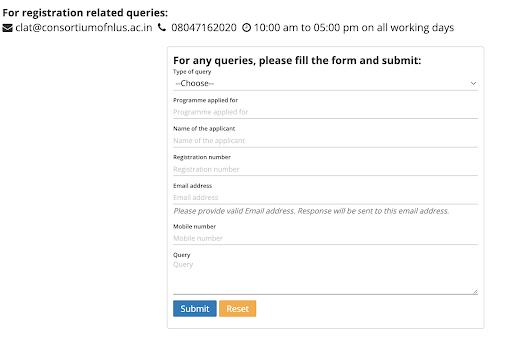
For any queries related to your center or queries related to your registration process, candidates can also write their concerns on the official website.
However, candidates should make sure that they fill out the CLAT 2027 Application Form in time, as most official websites crash due to heavy traffic in the last few days.